
Speech at the OECD Infrastructure Forum

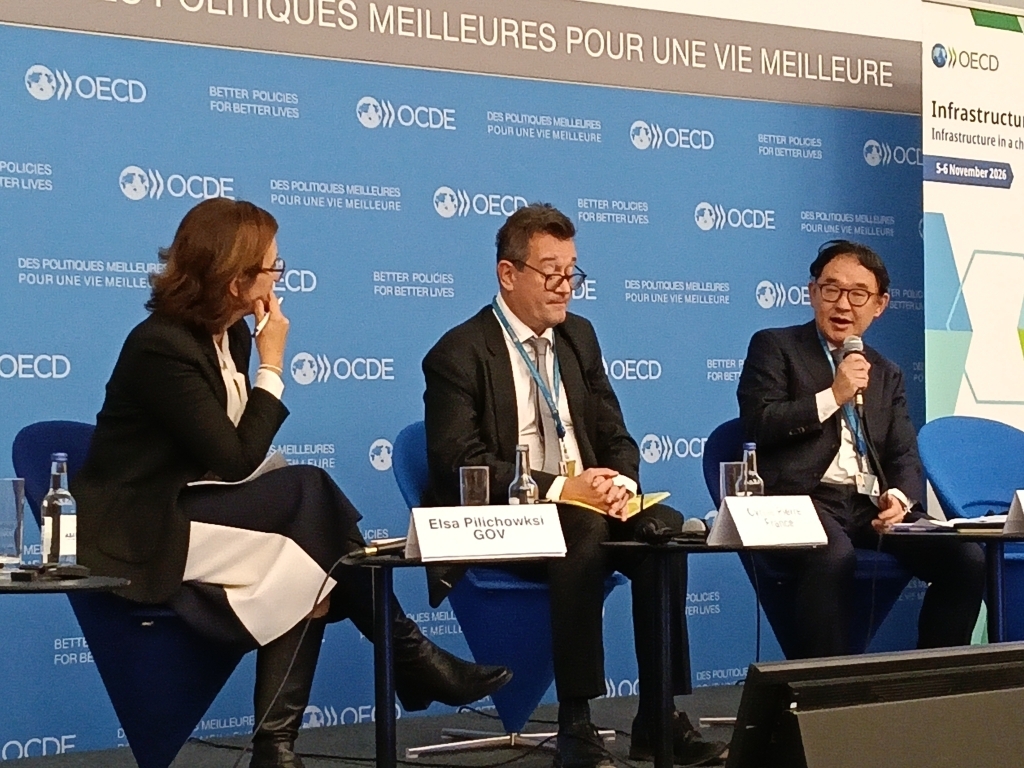
Speech (English)
Distinguished guests, ladies and gentlemen,
Thank you for the opportunity to speak with you today about our views and endeavors on the Quality Infrastructure Investment, or QII.
Let me begin by looking back at the origins of QII.
For developing countries to achieve self-reliant development, they must meet enormous demand for the infrastructure that supports people’s lives and economic activities.
However, simply building more infrastructure does not by itself deliver "quality growth," that is inclusive, sustainable and resilient. Even with a low initial investment, a project may have some shortcomings such as:
- It may incur significant operation and maintenance costs, making little economic sense over its entire life cycle;
- It may lack a viable medium- to long-term repayment plan, leading to default; or
- It may fail to account for natural disasters and other risks, leaving it vulnerable.
In those cases, infrastructure may end up hindering the very growth it was meant to support.
With this in mind, Japan has led the international community to establish global standards for QII.
The first step was the "G7 Ise-Shima Principles for Promoting Quality Infrastructure Investment" at the G7 Ise-Shima Summit in 2016, under Japan's Presidency.
In 2019, again under Japan's Presidency, the "G20 Principles for Quality Infrastructure Investment" were also endorsed at the G20 Osaka Summit. They brought emerging donor countries on board.
Over the same period, Japan itself expanded the supply of risk capital for infrastructure development under the "Expanded Partnership for Quality Infrastructure." This effort reached beyond Asia to the entire world. Between 2017 and 2021, Japan provided a total of more than 200 billion US dollars in support.
This year marks ten years since the Ise-Shima Summit. Around the world, extreme weather events such as heatwaves and floods are becoming more frequent. The resilience of infrastructure is once again being put to the test.
Looking back, I believe we can say that the concept of QII was remarkably forward-looking.
Let me start with the OECD.
The OECD has undertaken a wide range of activities related to the QII Principles. Today, I would like to highlight four initiatives that Japan particularly values and hopes to see develop further.
The first is the OECD's analysis and policy recommendations on structural challenges and governance in emerging markets, aimed at mobilizing private investment. This is an area where the OECD's expertise truly stands out. Japan has supported policy reviews of Asian countries through its voluntary contributions.
The second is the design of blended finance and de-risking measures to support infrastructure investment, as well as cross-cutting comparisons among the relevant institutions. Japan also provided a voluntary contribution to support this project.
Many institutions are involved in infrastructure development. Among them, the OECD's strengths lie in neutral and expert analysis, the facilitation of policy dialogue, and contributions to international standard-setting. To make the most of these strengths, we hope the OECD will further advance this project in cooperation with the Multilateral Development Banks.
The third is the Blue Dot Network, or BDN. Japan, together with the United States and Australia, launched the BDN in 2019, and its secretariat was established at the OECD in 2024.
The BDN is a framework that objectively assesses and certifies infrastructure projects against the QII Principles. It provides investors with clear and reliable benchmarks and is expected to turn private capital into quality infrastructure.
To date, ten projects have received BDN certification, including a few with the participation of Japanese companies.
The BDN is a meaningful initiative for promoting the quality infrastructure that Japan values so highly. We hope that raising the BDN's profile and increasing the number of certified projects will further mobilize private finance for quality infrastructure.
Finally, I would like to touch upon the efforts by the OECD Development Centre to embed the QII Principles on the ground. The Centre has systematized good practices in quality infrastructure. It has also fostered dialogue and mutual learning among stakeholders. Through these efforts, it has supported the development of a pipeline of infrastructure projects through PPPs.
Japan would like to deepen its cooperation with the OECD on these four initiatives, as well as on others.
Next, the World Bank.
In 2016, the Quality Infrastructure Investment Partnership, or QIIP, was established in cooperation with Japan. Its aim is to integrate the QII Principles into project preparation and implementation.
It operates as a trust fund financed by Japan's Ministry of Finance. To date, the Partnership has helped mainstream the QII Principles in more than 90 countries. Its support covers a wide range of sectors, including digital infrastructure and cybersecurity.
The QIIP has also extended its partnership model to the extractive industries.
It has begun working with two Japan-supported trust funds: the Extractives Global Programmatic Support (EGPS) and the Resilient and Inclusive Supply-chain Enhancement (RISE).
As its first operation in this field, the QIIP is supporting the Development of Resources for Energy and Mining Sector Support Project, known as the DREAM Project in Mauritania.
This program aims, among other things, to develop transmission infrastructure that can be shared by the public and private sectors. This will deliver solar and wind power to mining sites.
JICA, Japan's agency for implementing ODA, is also preparing projects that place great emphasis on disaster prevention, proper maintenance, and environmental and social considerations.
One example is the Jakarta Mass Rapid Transit project in Indonesia. The project helps ease severe traffic congestion and air pollution, supporting sustainable urban development. It is also being built with long-term operation and maintenance firmly in mind.
JICA also works in partnership with the Asian Development Bank, or ADB.
Together, they support infrastructure development through the Leading Asia's Private Infrastructure Fund 2, or LEAP2.
For example, last year, an agreement was reached to support the expansion and modernization of water supply and sewerage systems in Metro Manila.
This project does not end with construction. By building resilient infrastructure with high sanitation standards, it will contribute to the country's sustainable growth.
The concept of QII is also spreading to infrastructure investment that draws on private finance.
The Japan Bank for International Cooperation is supporting projects such as the Muara Laboh Geothermal Power Project in Indonesia, through co-financing with private financial institutions and the ADB.
This project combines infrastructure development with the energy transition. It is a clear example of the QII Principles in practice, promoting sustainable growth and environmental protection.
As these examples show, QII is no longer the effort of a single country or institution. It has become a shared global vision.
It is no exaggeration to say that the seeds sown in Ise-Shima have, over the past decade, come to flower in projects around the world.
What role, then, will the QII Principles play over the next ten years?
I believe their importance will only grow, as they help us respond to three structural changes that will shape future infrastructure demand.
The first is disaster risk and climate change...
The second is the energy transition...
The third is digitalization...
As infrastructure demand grows and evolves, the core principles of QII—life-cycle cost, sustainability and resilience—will become even more crucial.
Seen in this light, today's discussion at this Forum on the "High-Level Principles for Quality and Responsible Infrastructure" is most timely.
The world now faces complex and interlinked challenges, including natural disasters, urbanization, fiscal constraints and geopolitical uncertainty.
The High-Level Principles bring together important elements such as transparency and integrity, value for money across the life cycle, fiscal and debt sustainability, resilience, environmental management and the mobilization of private finance.
Over the next ten years, the concept of QII will become ever more important.
For its part, Japan will continue to contribute to the development of resilient and sustainable infrastructure, working hand in hand with the OECD, other international organizations and countries around the world.
Thank you.